A couple of blog widgets landed on my radar today, both of which offer readers some recommended links to other content articles to explore. MineKey claims to leverage individual reader behavior with the collective actions of all readers to help shape personalized content. RollSense doesn’t adapt to the reader, but it does examine up to 100 RSS feeds to find the best recent work to include in a sidebar.
Since I wasn’t getting a lot of value out of other recommender tools (look at what SphereIt doesn’t do for this article), I took some time to install them both for BlogSchmog readers to try out for a while.
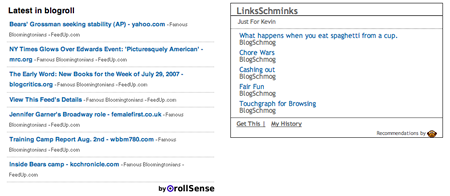
MineKey
MineKey launched their Beta on April 17. Within five weeks, the service had over 500 bloggers and an early click-through rate (CTR) of 6.35%. Although there were a few reviews back in May, the company is trying to test and iterate to get the bugs out before making a big splash in a crowded recommendation market. Yesterday, Minekey announced $3 million in funding. Several more blogs picked up that story, including the TechCrunch blurb that led me to the MineKey widget.
The technology uses several inputs to determine which links to recommend. The links are contextual to both the blog post content on the page and the RSS feeds included in the widget. But MineKey also attempts to track user actions on the blog, both collectively and personalized to the individual (as long as cookies are enabled and the reader has MineKey account). These four factors then spit out a list of links. The company tech page tries to explain the emergent properties that result:
The Minekey recommendations engine continuously analyzes the collective wisdom of all readers and experts (wisdom of the wise) visiting a specific blog or website to filter the content effectively and also to derive meaningful associations and relationships amongst the various “themes of interest.” These “themes of interest” along with the contextual information from content the user is currently browsing are then matched with the content aggregated from the feeds specified by the publisher to generate the most relevant recommendations.
Over time, Minekey’s personalization affinity algorithm pro-actively learns each user’s bias towards content that’s of personal interest or most popular with the global users on a website, the user’s friends, or users with similar browsing behavior and adjusts the recommendations accordingly.
Time will tell if this turns out to work. So far, all of the sites I visited with the MineKey widget installed were suggesting only other links on the same site, completely ignoring what I would want as a reader: a way to navigate to other relevant posts on other blogs. Without my cookie available (I tested on another browser), I got links off of our BlogSchmog site. It is also conceivable I configured my widget incorrectly, since on the blog of Minekey worker Rajiv Doshi there were two widgets—one with just internal links to his site and another with a couple external blogs listed as well.
The analytics are another draw. Every click is something that is counted and viewable in a report. Readers can track their own behavior through history pages, and blog authors can understand how the links are attracting people visiting the site.
RollSense
Read/Write Web recently reviewed RollSense, a link generator showing relevant articles published by your trusted content sources. This is intended to replace the static—and often very long—list of Blogroll links that are associated with the site being read.
Since RollSense allows the blog administrator to provide a list of up to 100 RSS feeds, all of the recommended articles will come from those sites. It is an easy matter to export an OPML file from Google Reader and upload it to RollSense. The recommended links are also meant to be relevant to the context of the current article. As with MineKey, there are some stats, although limited to impressions, clicks and the click-through rate.
RollSense is offering this content as a trial for the next two months. After October 2, members will be offered a chance to upgrade to a paying plan with more channels and feeds. Otherwise, the links—which are limited to three channels and 100 feeds per channel—will be mixed with sponsored links or ads.
Give both tools some time to become useful, then let us know if either of them prove helpful for you.