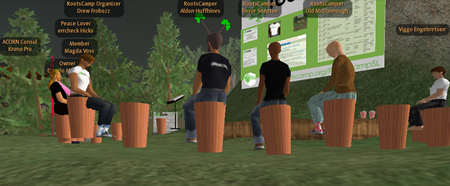
Aldon Hynes, who was the technology coordinator for the Lamont Campaign in Connecticut, held an online session of RootsCamp in Second Life this afternoon. He gave an overview of the kinds of technology used in the campaign, then talked about some of the decisions to use (or not use) technology. Aldon has several blogs.
“We wanted to find one system that would tie everything together nicely,” said Aldon. Because the first system didn’t work well, they had to cobble together a system from a half dozen applications that had varying degrees of integration. Scalability was a key feature. They looked for tools that had a low point of entry but could handle higher traffic surges as the campaign progressed. “It is interesting that the Lieberman camp didn’t really handle this,” he said. “Their website crashed under the volume of primary day traffic.”
The list of applications included BlueStateDigital (handling signups, emails and donations), Sage Systems (FEC filing, early voter ID), Google calendar and spreadsheets (internal and county events), Salesforce (important calendar management), and ActBlue (a PAC that bundles donations, responsible for early fundraising). “Our Family, Friends and Neighbors system was home grown, because Sage — which we hoped would handle things — couldn’t really keep up.”
Family, Friends and Neighbors is a creative use of strong ties in social networks to promote a candidate. Supporters visiting the site could create a user account and then pour over the list of registered voters to find names of people they knew. Next, a personal message would be created, which would be added to the back of a real postcard (not the e-variety). Since the recipient’s address information is already part of the same database, there is no need to ask for contact information or for the sender to bother with postage and mailing. The campaign headquarters takes care of that. Once the postcard is sent, the supporter gets notification so they can follow up on the card by contacting that friend. It was a way to start a dialogue about the candidate through a trusted network.
“Given all the campaign mail that goes out,” Aldon said, “having one that is personalized really helps.” He added that it important to get the cards out early, before voters get overwhelmed with campaign mailings.
Aldon also explained to virtual campers about the role of the Technologist in a campaign:
One the one hand, the technologist is very much operations. On the other hand, technology can and should be part of field and/or part of communications. Unfortunately, campaigns still tend to stick technology in one area or another and not make full use of the technology.
He tried to arrange a Lamont campaign event in Second Life, but no one had time to pursue it very far. Aldon said it would have been appropriate in other ways, since Joe Lieberman has a bad reputation with video games. Similar problems emerged with other social tools, like Facebook and MySpace.
For more information, go to the RootsCamp SL site. There are also some photos available on Flickr.
